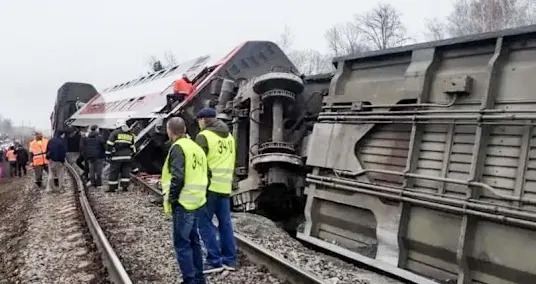
At least 55 people were injured in a serious train accident in Russia after the Moscow to Chelyabinsk night train derailed and seven double-decker carriages overturned.
No one was killed in the accident, according to state-run Russian news agency TASS, citing the authorities.
There were 415 passengers on board and at least 55 suffered minor or moderate injuries, regional governor Alexei Russkich said. Seventeen people are being treated in hospital, he said. Earlier reports put the number injured at 35.
Some of the passengers managed to climb out of the overturned carriages, as could be seen in a video on Telegram channel Baza.
The accident occurred near the village of Bryandino in the Ulyanovsk region, just under 800 kilometres east of Moscow, half way to Chelyabinsk in Western Siberia.
In seeking the cause of the incident, Russia’s State Investigative Committee pointed to the worn-out track bed, Interfax news agency reported.

LATEST POSTS
- 1
 The Benefits of Rehearsing Careful Nurturing
 - 2The most effective method to Integrate Compact disc Rates into Your Retirement Arranging
- 3'Not the moon that I'm used to seeing': Artemis II astronauts describe seeing the far side
- 4Lily Allen 2026 'West End Girl' arena tour: How to get tickets, prices and more
- 5Senegal limits foreign trips for officials as the fallout from Iran war deepens




- Fundamental Home Machines for Improved Solace in Summer
- Opening Potential: Self-awareness and Long lasting Learning
- See the first close-up photos of the moon from NASA's Artemis II mission
- Scientists detect X-ray glow from interstellar comet 3I/ATLAS extending 250,000 miles into space
- NASA’s history-making moon mission aims to send the first woman and person of color to deep space
- Step by step instructions to Look at Compact disc Rates: A Thorough Aide
- From ‘Project Hail Mary’ to Artemis II, spaceflight captures audiences when it centers on people because human space travel is hazardous
- NASA unveils close-up pictures of the comet popping by from another star
- Vietnam rethinks its flood strategy as climate change drives storms and devastation